Experiment s kvantovými stavmi
Experiment with Quantum States
Úvod
Moderná fyzika predpokladá, že kvantový svet je nelokálny a objekty mikrosveta sú v tzv. superpozícii. Jednoducho povedané, objekty mikrosveta môžu byť v rôznych stavoch zároveň, alebo na rôznych miestach súčasne. To je predstava modernej fyziky. Existuje však možnosť, že toto nie je správne tvrdenie. Tá možnosť sa dá dokonca (za stavu dnešnej meracej techniky) preveriť. Tento článok nadväzuje na diel v odkaze.
Kvantové previazanie
Previazané častice (z knihy EDQ teórie) sú spojené kvantovou strunou, ktorá sa vlní (stojaté vlnenie). Existuje teda nenulová funkcia zmeny stavov vzhľadom na čas.
To je priamo predpoklad teórie. Prečo práve tento predpoklad? Na to je viac dôvodov. Prvým a najsilnejším dôvodom je, že ak zavedieme túto strunu, priamo vytvoríme spojenie, ktoré medzi časticami existuje. Druhý podstatný dôvod je ten, že kvantová struna všetky záhady okolo kvantovej previazanosti vysvetlí.
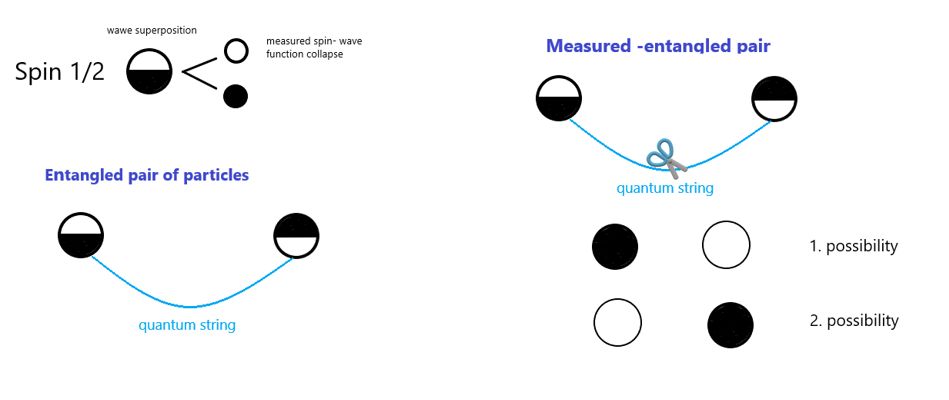
Obr. 1 Schematické, kvantové previazanie strunou.
Previazaný pár častíc na obrázku č. 1 je vo vlnovom stave. To je pojem z kvantovej fyziky. V tejto teórii to bude znamenať, že stav častice osciluje v čase. To je veľmi dôležitá zmena oproti kvantovej fyzike. V kvantovej fyzike totiž tento pojem znamená mŕtvu mačku, aj živú mačku zároveň.
Lenže to je predpoklad KM (interpretácia KM) a dá sa to obísť tak, že tieto dva stavy nie sú súčasné, ale tak, že oscilujú v čase, viď. obr.2. To znamená - tá istá previazaná častica má vo vlnovom stave chvíľku stav čierny, chvíľku stav biely. Druhá častica má presne v tom istom čase opačné stavy. Struna medzi previazanými časticami totiž kmitá stojatým vlnením. Žiadna informácia sa nešíri z jednej previazanej častice na druhú previazanú časticu. Nie je teda narušený postulát max. rýchlosti svetla – c.
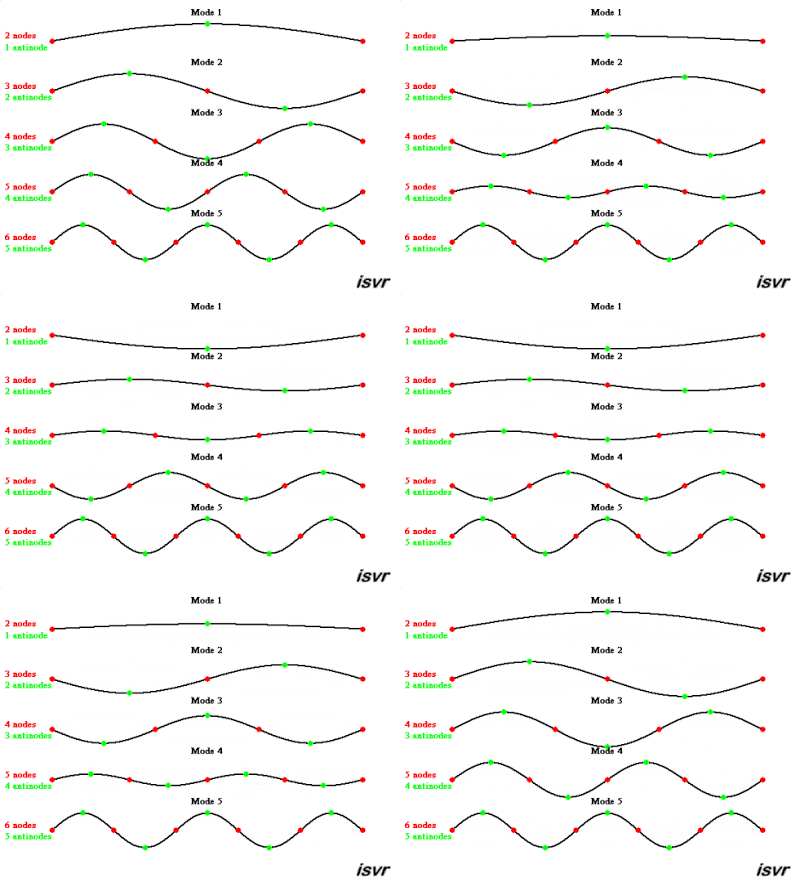
Obr.2 Stojaté vlnenie kvantovej struny.
Ak vykonáme meranie na jednej z previazaných častíc, struna sa pretrhne, nameriame konkrétne stavy na časticiach, prerušíme meraním previazanie.
Oproti štandardnej interpretácii kvantovej fyziky netvrdíme, že objekty neexistujú, kým ich nezmeriame, resp. nevieme čo je medzi tým. Netvrdíme to, že mesiac tu nie je, keď sa naň nepozeráme. Teória tvrdí, že vlnová povaha neznamená, že veci sú neurčité, len to, že pokiaľ nepoznáme presne vlnovú funkciu v čase, nedokážeme zistiť, ktorý stav nastane pri meraní.
Predpovede kvantových stavov
Vlnová funkcia medzi previazanými časticami môže nadobudnúť tieto tri základné možnosti:
- Predvídateľné harmonické vlnenie struny s konkrétnou periódou.
- Kvázi chaotické vlnenie struny (úseky pravidelnosti a úseky nepravidelnosti)
- Chaotické vlnenie struny.
Prenos informácii
V prípade 1,2 možnosti máme šancu cez túto vlastnosť poslať informáciu okamžite na druhú stranu, viac ako 50% informácií. V nadväznosti na zmienený pokus (diel v odkaze) vieme, že cez previazaný pár sa dá poslať 50% informácií okamžite. Pokiaľ budeme poznať ako struna kmitá, budeme vedieť poslať od 50-100% informácií.
Ako zistiť priebeh kmitania struny?
No zrejme by sme potrebovali celé sady previazaných častíc, ktoré by sme museli rovnako spriahnuť tak, aby sme dosiahli rovnaké kmitanie (pokiaľ je to možné). Následne by sme merali na jednotlivých previazaných časticiach stavy v závislosti na odstupňovanom čase. Týmto spôsobom by sme hľadali konkrétny priebeh kmitania kvantových strún. Vedeli by sme z nameraných hodnôt určiť priebeh funkcie. Pre jednoduché kmity by to problém nebol. Pokiaľ by struny kmitali chaoticky (nepredvídateľne), hľadanú funkciu by sme nevedeli zrekonštruovať.
V dnešnej dobe vieme dokonca zmerať kvantový stav aj nedeštruktívnymi metódami, čo by automaticky vylúčilo potrebu veľkej sady previazaných častíc. Preto je zaujímavé urobiť takýto pokus a hľadať tú funkciu kmitania kvantových strún. Zároveň v prípade úspechu by to viedlo k zmene interpretácie kvantovej fyziky.
Vnútenie kvantového stavu
Ďalšou a efektívnejšou metódou by bolo vnútiť previazenému páru požadovaný kvantový stav (na strane odosielateľa informácie).
Bolo by zaujímavé preveriť, či silné, usmernené magnetické pole nespôsobí na jednej z previazaného páru častíc, odklon pravdepodobnosti( >50 %) pri meraní spinu častice. Magentické pole priamo pôsobí na spin častice. Pri kolapse vlnovej funkcie, tak usmernené magnetické pole by mohlo tesne pred meraním posunúť pravdepodobnosť pre konkretny, kvantový stav. To by potom umožnilo odosielať informácie rýchlejšie >c.
Introduction
Modern physics assumes that the quantum world is non-local and objects in the microworld are in so-called superposition. Simply put, microworld objects can be in different states simultaneously, or in different places at the same time. This is the view of modern physics. However, there is a possibility that this is not a correct statement. This possibility can even be verified (with today's measurement technology). This article follows on the part in the link.
Quantum Entanglement
Entangled particles (from the EDQ theory book) are connected by a quantum string that waves (standing wave). Therefore, there is a non-zero function of state changes with respect to time.
This is a direct assumption of the theory. Why exactly this assumption? There are several reasons for this. The first and strongest reason is that if we introduce this string, we directly create a connection that exists between particles. The second essential reason is that the quantum string will explain all mysteries around quantum entanglement.
Fig. 1 Schematic, quantum entanglement by string.
The entangled pair of particles in Figure 1 is in a wave state. This is a concept from quantum physics. In this theory, it will mean that the state of the particle oscillates in time. This is a very important change from quantum physics. In quantum physics, this concept means a dead cat and a living cat at the same time.
But that is an assumption of QM (interpretation of QM) and it can be bypassed so that these two states are not simultaneous, but oscillate in time, see Fig. 2. This means - the same entangled particle in the wave state has sometimes a black state, sometimes a white state. The second particle has exactly opposite states at the same time. The string between entangled particles vibrates with standing waves. No information is transmitted from one entangled particle to another entangled particle. Therefore, the postulate of maximum speed of light – c is not violated.
Fig. 2 Standing wave of quantum string.
If we perform a measurement on one of the entangled particles, the string breaks, we measure specific states on the particles, we interrupt the entanglement by measurement.
Unlike the standard interpretation of quantum physics, we do not claim that objects do not exist until we measure them, or we do not know what is in between. We do not claim that the moon is not here when we are not looking at it. The theory states that the wave nature does not mean that things are indeterminate, only that if we do not know exactly the wave function in time, we cannot determine which state will occur during measurement.
Predictions of Quantum States
The wave function between entangled particles can take these three basic possibilities:
- Predictable harmonic string oscillation with a specific period.
- Quasi-chaotic string oscillation (sections of regularity and sections of irregularity)
- Chaotic string oscillation.
Information Transfer
In cases 1 and 2, we have a chance to send information instantly to the other side through this property, more than 50% of information. Following the mentioned experiment (part in the link), we know that 50% of information can be sent instantly through an entangled pair. If we know how the string vibrates, we will be able to send from 50-100% of information.
How to Determine the String Oscillation Pattern?
We would probably need entire sets of entangled particles that we would have to couple equally to achieve the same oscillation (if possible). Subsequently, we would measure states on individual entangled particles depending on graduated time. In this way, we would look for a specific pattern of quantum string oscillation. We would be able to determine the function pattern from measured values. For simple oscillations, this would not be a problem. If strings oscillated chaotically (unpredictably), we would not be able to reconstruct the searched function.
Nowadays, we can even measure quantum states with non-destructive methods, which would automatically eliminate the need for a large set of entangled particles. Therefore, it is interesting to do such an experiment and look for that function of quantum string oscillation. At the same time, in case of success, it would lead to a change in the interpretation of quantum physics.
Imposing Quantum State
Another and more efficient method would be to impose a required quantum state on the entangled pair (on the information sender side).
It would be interesting to verify whether a strong, directed magnetic field does not cause a deviation of probability (>50%) in measuring particle spin on one of the entangled pair particles. Magnetic field directly affects particle spin. During wave function collapse, such a directed magnetic field could shift the probability for a specific quantum state just before measurement. This would then allow sending information faster than >c.