Guy robin index
Úvod
Tento diel je venovaný výpočtu Guy Robin indexu pre obrovské čísla. Existuje ekvivalentný spôsobov ako Riemannovú hypotézu formulovať. Zameriam sa na tento výklad. (zdroj: výkladu).
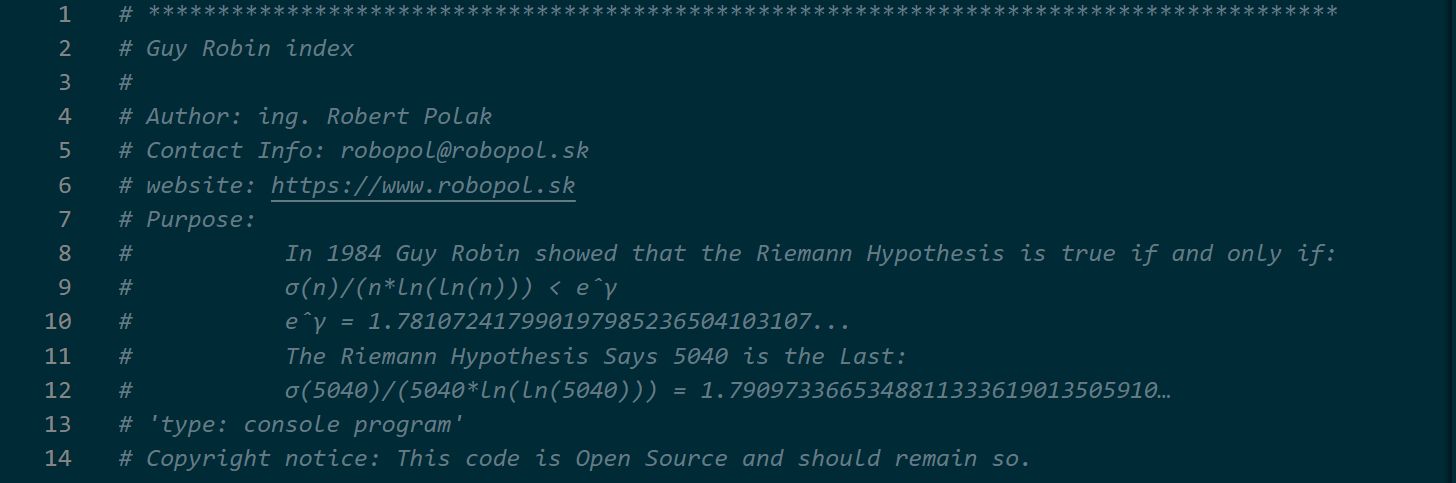
In 1984 Guy Robin showed that the Riemann Hypothesis is true if and only if:
σ(n)/(n*ln(ln(n))) < eˆγ
eˆγ = 1.781072417990197985236504103107...
The Riemann Hypothesis Says 5040 is the Last:
σ(5040)/(5040*ln(ln(5040))) = 1.7909733665348811333619013505910…
Tento algoritmus v nadväznosti na rozklad obrovských čísiel je nevyhnutný pre výpočet priebehu Guy Robin indexu v súvislosti s Riemannovou hypotézou. Algoritmus je efektívny a dokáže vypočítať tento index pre naozaj veľké čísla. Pri zadávaní čísiel zvažujte, že čím väčšie číslo zadávate (dlhý prvočíselný rozklad), tak tým väčšiu pamäť počítača si algoritmus vyžiada.
Zdrojový kód programu
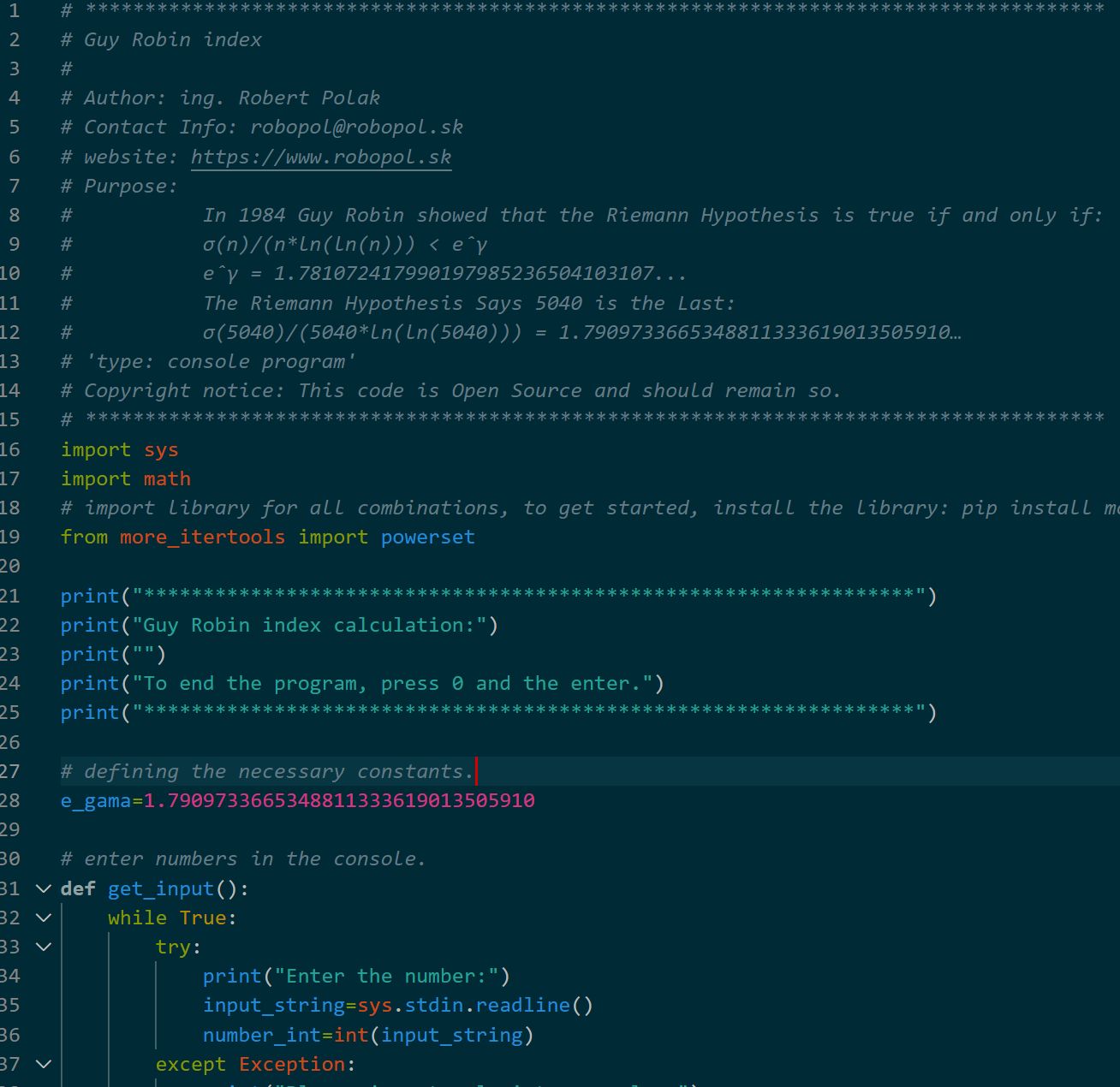
Obr.1 Ukážka kódu v Pythone.
Verzia č.1:
download súboru v Pythone: guy_robin_index.py
Pozrieť kód vo formáte ".txt": guy_robin_index.txt
alebo stiahnuť kód z GitHub:
guy_robin_index.py
Verzia č.2: (nepotrebuje inštalovať knižnicu more-itertools)
download súboru v Pythone: guy_robin_ver_2.py
Pozrieť kód vo formáte ".txt": guy_robin_ver_2.txt
alebo stiahnuť kód z GitHub:
guy_robin_ver_2.py
Popis: Algoritmus obsahuje výpočet Guy Robin indexu pre veľké čísla.
Príklady výpočtu Guy Robin indexu:
Tento program bol vytvorený v programovacom jazyku Python. Ide o konzolový program. Pre spustenie je potrebné si nainštalovať Python, alebo si program spustiť online cez prehliadač. Bližšie o inštalácii a spustení programu v Pythone nájdete v článku : Matematika v Pythone.
Tento program vyžaduje aj nainštalovanie knižnice
more-itertools pre verziu č.1. Inštaláciu urobíte po nainštalovaní Python na Váš
počítač. Do príkazového riadku (vo windows) napíšete príkaz :
pip install more-itertools
Následne sa nainštaluje knižnica. Potom spustíte program
napr. v IDLE (je súčasťou inštalácie pythonu, nájdete v ponuke štart win).

Obr.2 Príklad výpočtu Guy robin indexu.
Program naozaj zvláda veľké čísla v krátkom čase. Ak by ste však zadali jedno z tých najväčších napr. N=8201519488959040182625924708238885435575055666675808000 , tak Vám pravdepodobne vyhodí hlášku, že máte málo pamäti. Tento výpočet vyžaduje zrátať naozaj veľký počet kombinácii v rozklade tohto čísla, takže tu je potrebné mať veľkú pamäť.Verzia č.2 vyžaduje menej pamäte.
Skúsme druhého kandidáta, ktorý sa v literatúre uvádza:
N=305814813222015262144204919364909926547065946955998182400000
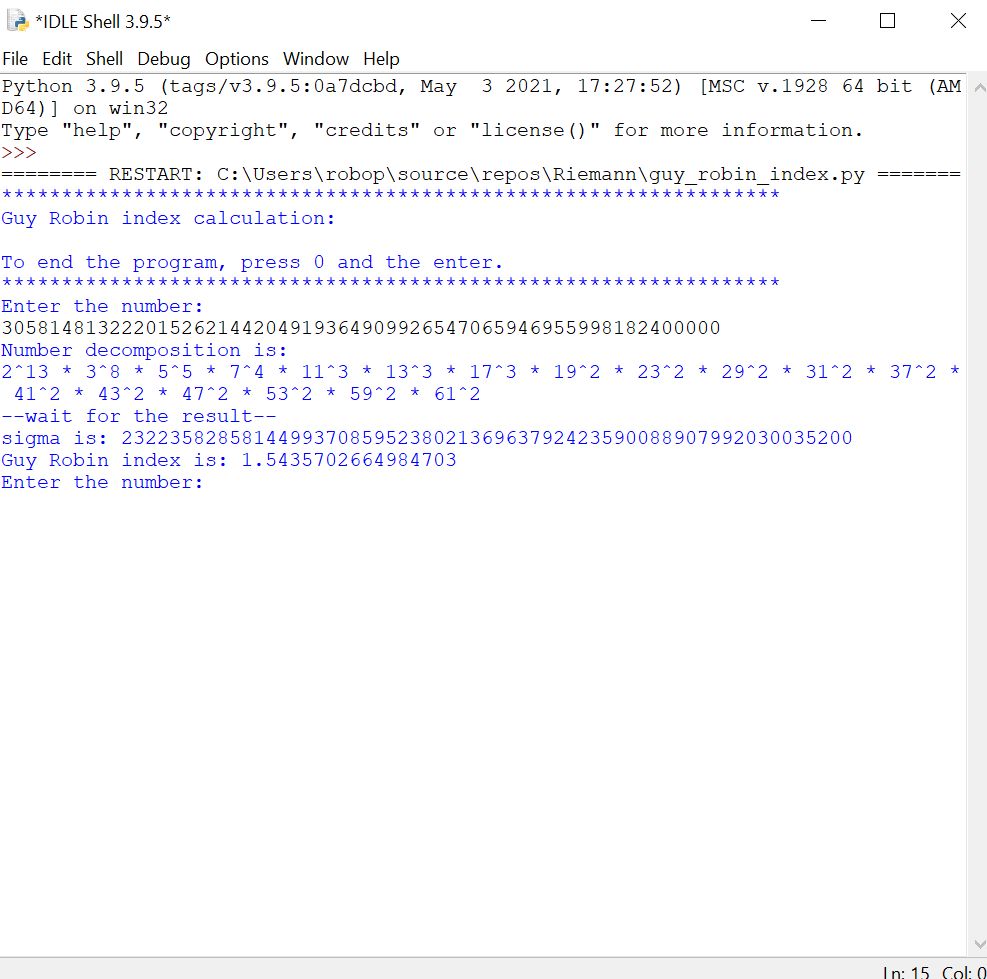
Obr.3 Druhý príklad veľkého čísla
Všimnime si, že index je relatívne malý, pričom tento rozvoj sa uvádza, kde Guy Robin index je vysoký (čo je zaujímavé, tento program pracuje správne). Tu nebola pamäť v rozvoji nedostatočná, pretože rozvoj je kratší.

Obr.4 Ďalšie príklady dlhých rozvojov.
Pre predstavu pc ráta pre výpočet SIGMA :všetky kombinácie čísiel rozvoja a násobí ich medzi
sebou.
napr. počet kombinácií combination (27,13)=20 058 300. To je len počet kombinácii
rozvoja s 27 prvočíslami pre všetky kombinácie kde je k=13. No je potrebné urobiť pre všetky
k=1,2,3,...27.
Záver
Dúfam, že tieto informácie, program sa čitateľom páčil (Zdieľajte, lajkujte).
Tento program je nevyhnutným pre preverenie Riemannovej hypotézy pre naozaj veľké čísla. Kód programu sa dá pozmeniť tak, aby pri obrovskom prvo-číselnom rozklade rátal kombinácie postupne, čím znížime nároky na pamäť počítača. Toto opatrenie je vytvorené vo verzii č.2.
Introduction
This part is dedicated to calculating the Guy Robin index for enormous numbers. There is an equivalent way to formulate the Riemann Hypothesis. I will focus on this interpretation. (source: interpretation).
In 1984 Guy Robin showed that the Riemann Hypothesis is true if and only if:
σ(n)/(n*ln(ln(n))) < eˆγ
eˆγ = 1.781072417990197985236504103107...
The Riemann Hypothesis Says 5040 is the Last:
σ(5040)/(5040*ln(ln(5040))) = 1.7909733665348811333619013505910…
This algorithm, in connection with factorization of huge numbers, is necessary for calculating the Guy Robin index progression in relation to the Riemann Hypothesis. The algorithm is efficient and can calculate this index for really large numbers. When entering numbers, consider that the larger the number you enter (long prime factorization), the more computer memory the algorithm will require.
Program Source Code
Fig. 1 Code sample in Python.
Version #1:
download Python file: guy_robin_index.py
View code in ".txt" format: guy_robin_index.txt
or download code from GitHub:
guy_robin_index.py
Version #2: (does not require installing more-itertools library)
download Python file: guy_robin_ver_2.py
View code in ".txt" format: guy_robin_ver_2.txt
or download code from GitHub:
guy_robin_ver_2.py
Description: The algorithm contains calculation of Guy Robin index for large numbers.
Examples of Guy Robin Index Calculation:
This program was created in Python programming language. It is a console program. To run it, you need to install Python, or run the program online through a browser. More about installation and running the program in Python can be found in the article: Mathematics in Python.
This program also requires installing the
more-itertools library for version #1. You will do the installation after installing
Python on your computer. In the command line (in Windows) you type the command:
pip install more-itertools
Then the library will be installed. Then you run the
program, e.g., in IDLE (part of Python installation, found in Windows start menu).
Fig. 2 Example of Guy Robin index calculation.
The program really handles large numbers in a short time. However, if you entered one of the largest, e.g., N=8201519488959040182625924708238885435575055666675808000, it would probably give you a message that you have too little memory. This calculation requires counting a really large number of combinations in the factorization of this number, so you need large memory. Version #2 requires less memory.
Let's try the second candidate mentioned in literature:
N=305814813222015262144204919364909926547065946955998182400000
Fig. 3 Second example of large number
Notice that the index is relatively small, while this development is cited where the Guy Robin index is high (which is interesting, this program works correctly). Here memory was not insufficient in development because the development is shorter.
Fig. 4 Additional examples of long developments.
For perspective, the PC calculates for SIGMA computation: all combinations of development numbers
and multiplies them among themselves.
e.g., number of combinations combination
(27,13)=20,058,300. That's just the number of development combinations with 27 primes for all
combinations where k=13. But it's necessary to do for all k=1,2,3,...27.
Conclusion
I hope that this information and program were liked by readers (Share, like).
This program is essential for verifying the Riemann Hypothesis for really large numbers. The program code can be modified so that with enormous prime factorization it calculates combinations progressively, thereby reducing computer memory requirements. This measure is implemented in version #2.