Interpretácia kvantovej teórie
Interpretation of Quantum Theory
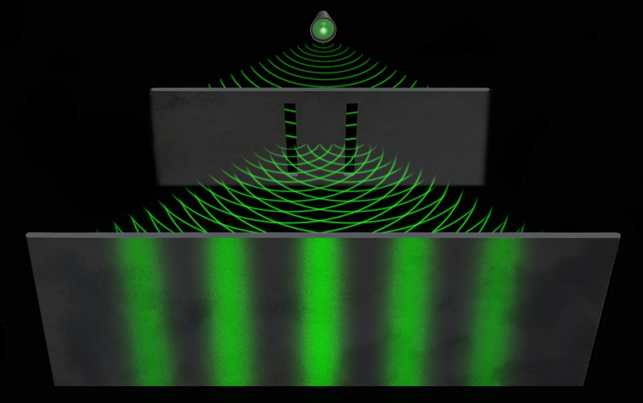
Nedeterminizmus kvantovej fyziky. V kvantovej fyzike nie sme schopný povedať, ktorý výsledok presne nastane. V kvantovej fyzike dokážeme určiť iba pravdepodobnosti výsledných udalosti.
Interpretácia kvantovej teórie
Matematický formalizmus kvantovej teórie je kuchárska kniha, ktorá obsahuje recepty ako predpovedať experimenty. Neobsahuje však hlbšie poznanie súvislosti a chovania sa objektov v mikrosvete. Kvantová teória obsahuje odlišné správanie sa ako v makrosvete. Interpretácia - "filozofia kvantovej teórie" nesmierne zaujímavá z hľadiska otázok, ako vniesť hlbšie pochopenie a súvislosti receptov matematického formalizmu kvantovej teórie. Ide predovšetkým o nájdenie ucelenej predstavy vysvetliť niektoré dôležité aspekty aparátu kvantovej teórie a ich previazanosti.
Druhy interpretácii:
- Kodanská interpretácia.
- Mnohosvetová interpretácia.
- Holografická interpretácia.
- Interpretácia súvisiaca s vedomím.
- Iné interpretácie
Kodanská interpretácia
Kodanská interpretácia vznikla v rokoch 1924 až 1927. Táto interpretácia kvantovej teórie je najrozšírenejšou a najviac prijímanou interpretáciou zo všetkých. Za autorov interpretácie sa považujú N. Bohr a W. Heisenberg. Kvantová teória nie je schopná predpovedať presný výsledok, ale iba pravdepodobnosť s akou sa stane. Pravdepodobnosť je daná kvadrátom vlnovej funkcie.
Niels Bohr viedol dlhé debaty s A. Einsteinom o podivnostiach kvantovej fyziky. Einsteinov známy výrok "Boh nehrá kocky", ktorým jasne ukazoval svoj postoj ku kvantovej fyzike ako neúplnej teórii.
V Bohrovej predstave meranie spôsobuje zmenu výsledku. Správanie sa objektov mikrosveta má duálny charakter a správa sa, alebo ako "častica", alebo ako "vlnenie". Teda sú to dve vlastnosti, ale jednej fenomenality. Bohr teda nehovorí, že to je oddelené, ale spojené a má to vlastnosti korpuskule, alebo vlnenia v závislosti od situácie. Navrhol teda komplementárny popis kvantovej mechaniky, v závislosti od zásahu merania v experimente. Dôležité zistenie bolo, že nejde merať, pozorovať obe vlastnosti súčasne, teda časticové-korpuskulárne chovanie a vlnové chovanie.
Pred meraním je teda systém v superpozícii vlnového stavu všetkých možnosti. Meraním dôjde ku kolapsu vlnovej funkcie a vznikne konkrétny stav. Túto podivnosť kvantového sveta ilustruje obr.1.
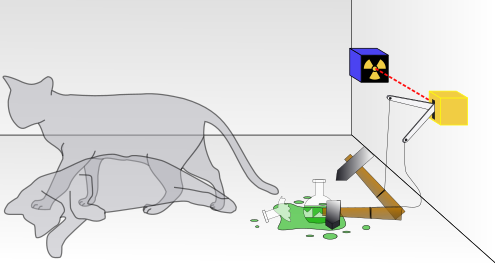
Obr.
1 Schrödingerová mačka, zdroj: Wikipédia.
Mnohosvetová interpretácia
S touto interpretáciou prišiel Everett v roku 1957. Podstatou tejto interpretácie je to, že v našom svete sa realizuje len jedna možnosť, stav. No pokiaľ existuje mnoho vesmír, potom by sa pri kolapse vlnovej funkcie (aktom merania) realizovali všetky možnosti v paralelných realitách. Táto interpretácia však nie je skutočnou interpretáciou kvantovej teórie, ale možnosť realizácie všetkých stavov, ktoré by sa mohli realizovať.
Holografická interpretácia
Za autora možno považovať teoretického fyzika D. Bohma. Táto interpretácia rieši hlavne nelokálnosť kvantovej teórie. Podľa tejto predstavy vnímame častice priestorovo aj časovo oddelené. Podľa tejto predstavy existuje akýsi súhrnný potenciál, ktorý všetky častice ovplyvňuje a zároveň spája do jedného celku. Pričom sa tu objavujú myšlienky, že realita, ktorú vnímame je len hologram inej skutočnej reality.
Interpretácia súvisiaca s vedomím
Táto predstava je skôr ezoterickou interpretáciou. S touto interpretáciou prišiel John von Neumann v roku 1932. Podľa tejto interpretácie kolaps vlnovej funkcie, teda nameranie konkrétnej reality spôsobujú vedomí pozorovatelia. Ja to osobne považujem za absurdnosť. Veľa "fyzikov" potom nahralo ezoterikom na rôzne prednášky a dokumenty o podstate kvantovej fyziky.
Hranice kvantového sveta
Kde je hranica dvoch svetov: makrosveta a mikrosveta? Zdá sa, že neexistuje ostrá hranica medzi týmito svetmi. Rakúsky fyzik A. Zeilinger a kolektív prevádzal experimenty na Talbotovom interferometre (štrbinový experiment) pre rôzne molekuly. Medzi najväčšie molekuly patrila molekula C60F48 s 1630 nukleónmi. Experimenty ukázali, že aj takáto veľká molekula vykazuje interferenčný obrazec, pokiaľ teda nijak molekula neinteragovala s okolitým prostredím, a nebolo teda možné zistiť kadiaľ molekula prešla.
Interferenčný obrazec sa objavil pri poklese teploty molekuly. Molekula teda nevysielala žiadne fotóny, ktoré by prezradili kadiaľ prešla (ktorým otvorom). Tým sa potvrdili presne stanovené vlastnosti kvantovej teórie, že dôležitá nie je veľkosť, ale vzájomná interakcia s okolím.
Záver
Interpretácia kvantovej fyziky nie je ľahký oriešok. No z toho, čo naozaj vieme nemáme žiadne dobré predstavy o tom, akoby sa to mohlo v prírode realizovať.
Nondeterminism of quantum physics. In quantum physics we are not able to say which result will occur exactly. In quantum physics we can only determine the probabilities of resulting events.
Interpretation of Quantum Theory
The mathematical formalism of quantum theory is a cookbook that contains recipes for how to predict experiments. However, it does not contain deeper knowledge of connections and behavior of objects in the microworld. Quantum theory contains different behavior than in the macroworld. Interpretation - "philosophy of quantum theory" is extremely interesting from the perspective of questions of how to bring deeper understanding and connections of recipes of mathematical formalism of quantum theory. It is primarily about finding a coherent idea to explain some important aspects of the quantum theory apparatus and their interconnections.
Types of interpretations:
- Copenhagen interpretation.
- Many-worlds interpretation.
- Holographic interpretation.
- Consciousness-related interpretation.
- Other interpretations
Copenhagen Interpretation
The Copenhagen interpretation was created in the years 1924 to 1927. This interpretation of quantum theory is the most widespread and most accepted interpretation of all. N. Bohr and W. Heisenberg are considered the authors of the interpretation. Quantum theory is not capable of predicting the exact result, but only the probability with which it will happen. The probability is given by the square of the wave function.
Niels Bohr led long debates with A. Einstein about the oddities of quantum physics. Einstein's famous statement "God does not play dice," with which he clearly showed his attitude towards quantum physics as an incomplete theory.
In Bohr's conception, measurement causes a change in the result. The behavior of microworld objects has a dual character and behaves either as a "particle" or as "wave." So these are two properties, but of one phenomenality. Bohr therefore does not say that it is separate, but connected and has properties of corpuscle or wave depending on the situation. He therefore proposed a complementary description of quantum mechanics, depending on the measurement intervention in the experiment. An important finding was that it is not possible to measure, observe both properties simultaneously, i.e., particle-corpuscular behavior and wave behavior.
Before measurement, the system is therefore in superposition of wave state of all possibilities. Measurement causes wave function collapse and a concrete state emerges. This oddity of the quantum world is illustrated in Fig. 1.
Fig.
1 Schrödinger's cat, source: Wikipedia.
Many-Worlds Interpretation
Everett came up with this interpretation in 1957. The essence of this interpretation is that in our world only one possibility, state is realized. But if there are many universes, then during wave function collapse (by the act of measurement) all possibilities would be realized in parallel realities. However, this interpretation is not a real interpretation of quantum theory, but a possibility of realizing all states that could be realized.
Holographic Interpretation
Theoretical physicist D. Bohm can be considered the author. This interpretation mainly solves the non-locality of quantum theory. According to this conception, we perceive particles spatially and temporally separated. According to this conception, there exists some comprehensive potential that influences all particles and at the same time connects them into one whole. Here ideas appear that the reality we perceive is only a hologram of another real reality.
Consciousness-Related Interpretation
This conception is rather an esoteric interpretation. John von Neumann came up with this interpretation in 1932. According to this interpretation, wave function collapse, i.e., measurement of concrete reality is caused by conscious observers. I personally consider this absurd. Many "physicists" then contributed to esotericists for various lectures and documents about the nature of quantum physics.
Boundaries of the Quantum World
Where is the boundary between two worlds: macroworld and microworld? It seems that there is no sharp boundary between these worlds. Austrian physicist A. Zeilinger and team conducted experiments on Talbot interferometer (slit experiment) for various molecules. Among the largest molecules was the C60F48 molecule with 1630 nucleons. The experiments showed that even such a large molecule shows interference pattern, provided that the molecule did not interact with the surrounding environment, and it was therefore not possible to determine which way the molecule passed.
The interference pattern appeared when the molecule temperature dropped. The molecule therefore did not emit any photons that would reveal which way it passed (through which opening). This confirmed the precisely established properties of quantum theory, that size is not important, but mutual interaction with the environment.
Conclusion
The interpretation of quantum physics is not an easy nut to crack. But from what we really know, we have no good ideas about how this could be realized in nature.